Updated Sep 24, 2026 18 min read

Generative AI in Software Testing: Use Cases, Benefits, Risks, and Implementation Guide
Explore how generative AI is transforming software testing, from test case generation and automation to defect analysis, key risks, and practical implementation.
Generative AI is already part of software development and testing workflows. Google's DORA research, based on survey responses from nearly 5,000 technology professionals worldwide, found that 90% use AI at work and more than 80% believe it has increased their productivity. Yet 30% reported little or no trust in AI-generated code.
This guide explains where generative AI fits into modern software testing, which use cases provide practical value, how GenAI differs from broader AI-assisted and agentic testing, the risks teams need to control, and how to introduce it without weakening test intent, validation, or release confidence.
Key Takeaways
- Generative AI is only one part of the broader AI-testing landscape. Predictive models, computer vision, self-healing automation, and agentic systems may use different techniques.
- An LLM should not be treated as the source of truth for expected results.
- As AI systems gain access to repositories, test environments, browsers, APIs, or other tools, security and governance become part of the testing architecture.
- AI-generated test cases should be reviewed before they enter a maintained test suite or influence release decisions.
What Is Generative AI in Software Testing?
Generative AI refers to models that create new content from the context they receive. In QA, that content may include test scenarios, test cases, automation code, API payloads, synthetic or generated test data, defect summaries, exploratory testing ideas, and documentation.
Generative AI Is Not the Same as Test Automation
Test automation executes defined logic and verifies actual behavior against expected results. Generative AI can help create tests, but it does not replace reliable execution, meaningful assertions, controlled test data, or validated expected results. Adding an LLM to a QA workflow does not make the entire process generative AI.
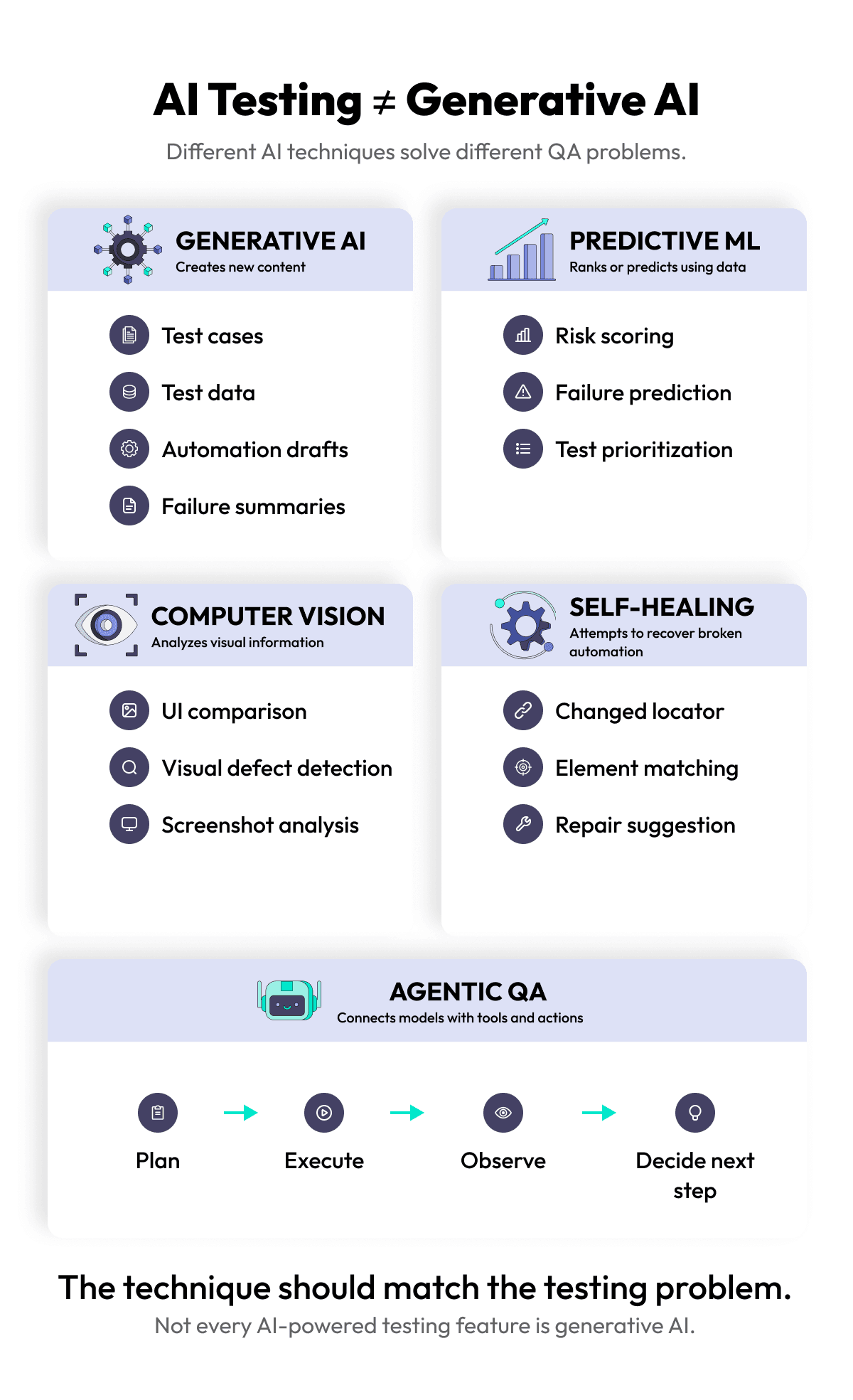
Generative AI, AI-Assisted Testing, and Agentic Testing
Several technologies are often grouped under the label “AI testing,” although they solve different problems.
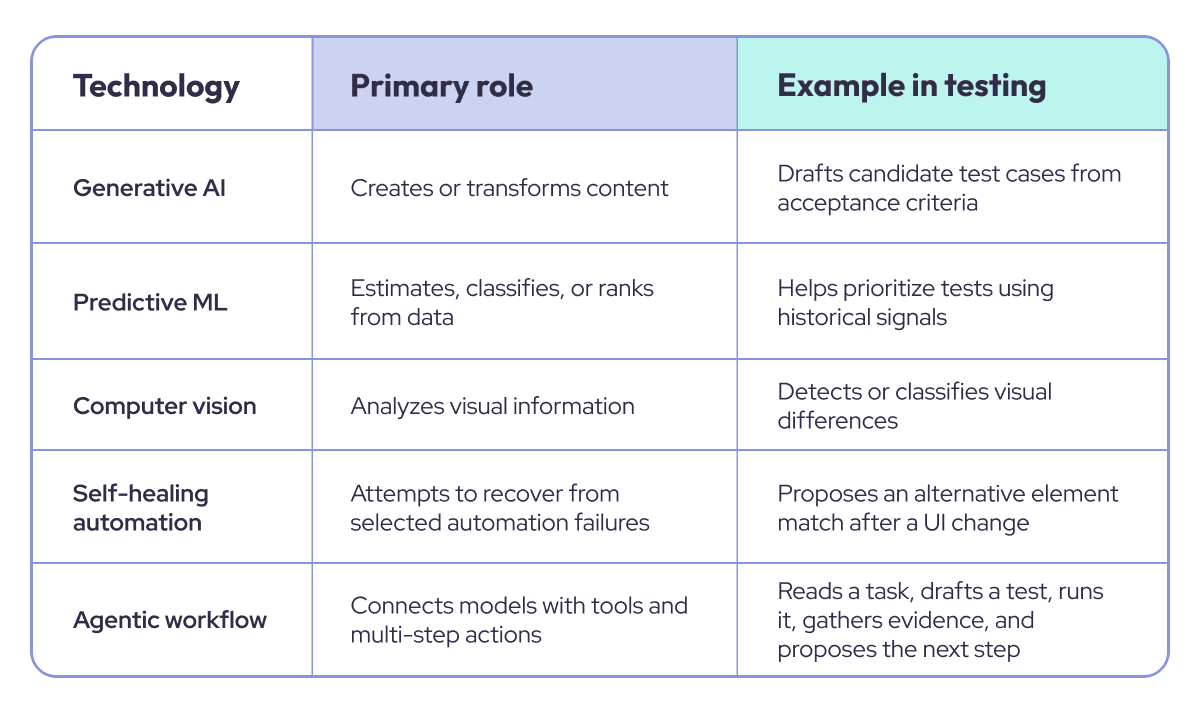
AI Testing Is Broader Than Generative AI
Why QA Teams Are Adopting Generative AI Now
Generative AI can process requirements, test artifacts, code, and execution data to produce drafts, summaries, and candidate scenarios. In QA, this makes it useful for drafting test cases, generating test data, assisting with automation code, summarizing failures, and suggesting exploratory testing ideas. A practical benefit is reducing repetitive preparation while giving testers more material to review, refine, and validate.
How Generative AI Is Changing the QA Process
Generative AI is easier to understand as another layer in the evolution of testing, not as a replacement for everything that came before it.
From Manual Testing to Scripted Automation
In testing, we often talk about the “balance between manual and automated testing,” but this is a misleading way to think about it. Testing is not about dividing work into manual or automated. It is a process of exploring and verifying the product. When faced with a certain task, the focus should not be on “balance,” but instead on which tools and approaches are best suited to accomplish that task.
Manual testing is indispensable, as manual test cases serve as the foundation for future automation. Manual testing revolves around the aspects that automated testing can't cover. These include visual application checks and the ability to test specific user experience-based scenarios that are impractical to automate. On the other hand, automated testing has its advantages. It eliminates the human factor, allows you to use the same scenarios repeatedly, and is much faster than manual testing.
Moreover, manual testing experience is invaluable for automation testers. Understanding the app from a user's perspective helps automation testers write better scripts and prioritize what to automate.
From Scripted Automation to AI-Assisted Testing
Generative AI can speed up the preparation of testing artifacts. QA engineers can provide requirements, acceptance criteria, product rules, API documentation, existing tests, and known risks, and use the model to generate an initial draft.
That output still requires review for incorrect assumptions, duplicated scenarios, missing risks, weak assertions, and inaccurate expected results. AI can accelerate preparation, but product correctness remains a human responsibility.
From AI Assistance to Agentic QA Workflows
Agentic QA workflows go further by allowing AI systems to select and sequence actions and interact with approved tools. For example, an agent may analyze a ticket, review related requirements and tests, identify coverage gaps, execute authorized checks, collect logs and screenshots, and prepare a draft defect report. As AI gains access to repositories, APIs, environments, or external systems, permissions, approval boundaries, auditability, and tool access become part of the security and governance design.
The OWASP Top 10 for LLM and GenAI Applications highlights relevant risks such as prompt injection, sensitive information disclosure, improper output handling, and excessive agency.
What Remains Under Human Control
AI can help collect, organize, and analyze testing information, but it should not define what “correct” means. We still need human ownership of requirement interpretation, business-rule validation, generated test approval, expected results, coverage decisions, environment access, and release decisions. The greater the impact of an AI action, the stronger the controls should be.
AI won’t catch what it doesn’t know to look for. That’s why you need us. Partner with our team of professionals and experience software quality that keeps you ahead of the competition.
Core Generative AI Use Cases in Software Testing
Many practical generative AI use cases in software testing produce outputs that QA teams can review and validate before relying on them.
AI-Generated Test Cases From Requirements
GenAI can turn requirements, user stories, and acceptance criteria into candidate positive, negative, boundary, and edge-case scenarios. For example, if a checkout requirement allows one active promotional code, a model may suggest tests for valid, expired, and invalid codes, repeated application, and code removal. If the requirement does not explain what should happen when a second code is entered, however, the model should not invent the expected behavior.
A reliable workflow is: Requirement → AI-generated candidates → QA review → Approved tests.
Natural-Language Test Authoring
Some testing tools can translate natural-language instructions into executable test steps or automation code. This can reduce the effort required to create straightforward tests, but it does not remove the complexity of authentication, asynchronous behavior, integrations, permissions, test data, or environment management. Natural-language authoring is therefore another way to create automation, not a replacement for sound test architecture.
Automation Code Generation
Code-capable LLMs can help draft browser automation with Playwright or Cypress and mobile automation with Appium clients. Generated code still requires technical review for selectors, assertions, test data, expected behavior, and security considerations.
Automated Bug Report Summarization
AI assistants can summarize logs, traces, screenshots, API responses, and other execution evidence into a draft defect report. The distinction between evidence and hypothesis matters. “The payment API returned success, but no order confirmation was created” describes observed evidence. “A race condition caused the defect” is a possible root cause and should remain a hypothesis until engineering evidence confirms it.
AI-Assisted Exploratory Testing
Exploratory testing relies on human creativity, intuition, critical thinking, and product knowledge. Testers use these skills to investigate the application, follow unexpected behavior, and uncover issues that predefined test cases may miss. GenAI can support this process by suggesting scenarios, edge cases, and questions worth investigating. For a checkout flow, for example, it might suggest testing an expired discount, inventory changes before payment confirmation, delayed provider callbacks, or session expiration. The tester still decides which scenarios are relevant and how deeply to investigate them.
API Testing With Generative AI
Given an API specification, GenAI can propose valid and invalid requests, missing fields, boundary values, authorization scenarios, malformed payloads, and unusual parameter combinations. QA still needs to verify more than the HTTP status code. Depending on the API, validation may include response content and schema, authorization rules, persistence, idempotency, downstream events, side effects, and resulting business state.
Generative AI Models and Related AI Approaches in Software Testing
Different AI models and techniques support different testing tasks. Some generate text, code, images, or synthetic data, while related approaches such as reinforcement learning and agentic systems support adaptive and multi-step QA workflows.
Large Language Models for Test Design
Large language models can work with requirements, user stories, acceptance criteria, specifications, and existing tests to suggest positive, negative, boundary, permission, and state-transition scenarios. Their output still requires review because models can introduce unsupported assumptions.
Code-Capable Models for Automation Scripts
Code-capable language models can draft automation for frameworks such as Playwright and Cypress or generate code for use with Appium clients. They can assist with setup, assertions, helper functions, API requests, test-data variations, and common interaction patterns, but generated code still requires technical review.
Multimodal Models for UI Analysis
Multimodal models can process combinations of text, screenshots, and other UI context. In testing, they can help interpret interface states, identify potentially inconsistent visible content, and suggest scenarios based on what appears on screen. Their observations should be reviewed rather than treated as confirmed defects.
Generative Models for Synthetic Test Data
Synthetic test data can be created using language models, statistical or probabilistic methods, GANs, VAEs, or diffusion models. These approaches can generate customer profiles, transactions, API payloads, unusual inputs, and larger datasets for testing. Synthetic data is not automatically anonymous or privacy-safe, so its source, generation method, and privacy risks still need to be evaluated.
Reinforcement Learning for Adaptive Test Exploration
Reinforcement learning is not a type of generative AI. It learns a policy from feedback received while interacting with an environment. In software testing, RL can support adaptive exploration by selecting actions or application states according to defined objectives.
Agentic AI Systems for Multi-Step QA Workflows
Agentic testing is not a separate type of AI model. It describes systems in which models are connected to tools and can perform multiple actions based on intermediate results. A testing agent might analyze requirements, create tests, execute them, inspect failures, and decide what action to take next. Generative models create or transform content, while agentic systems combine models, tools, execution, and feedback into a multi-step workflow.
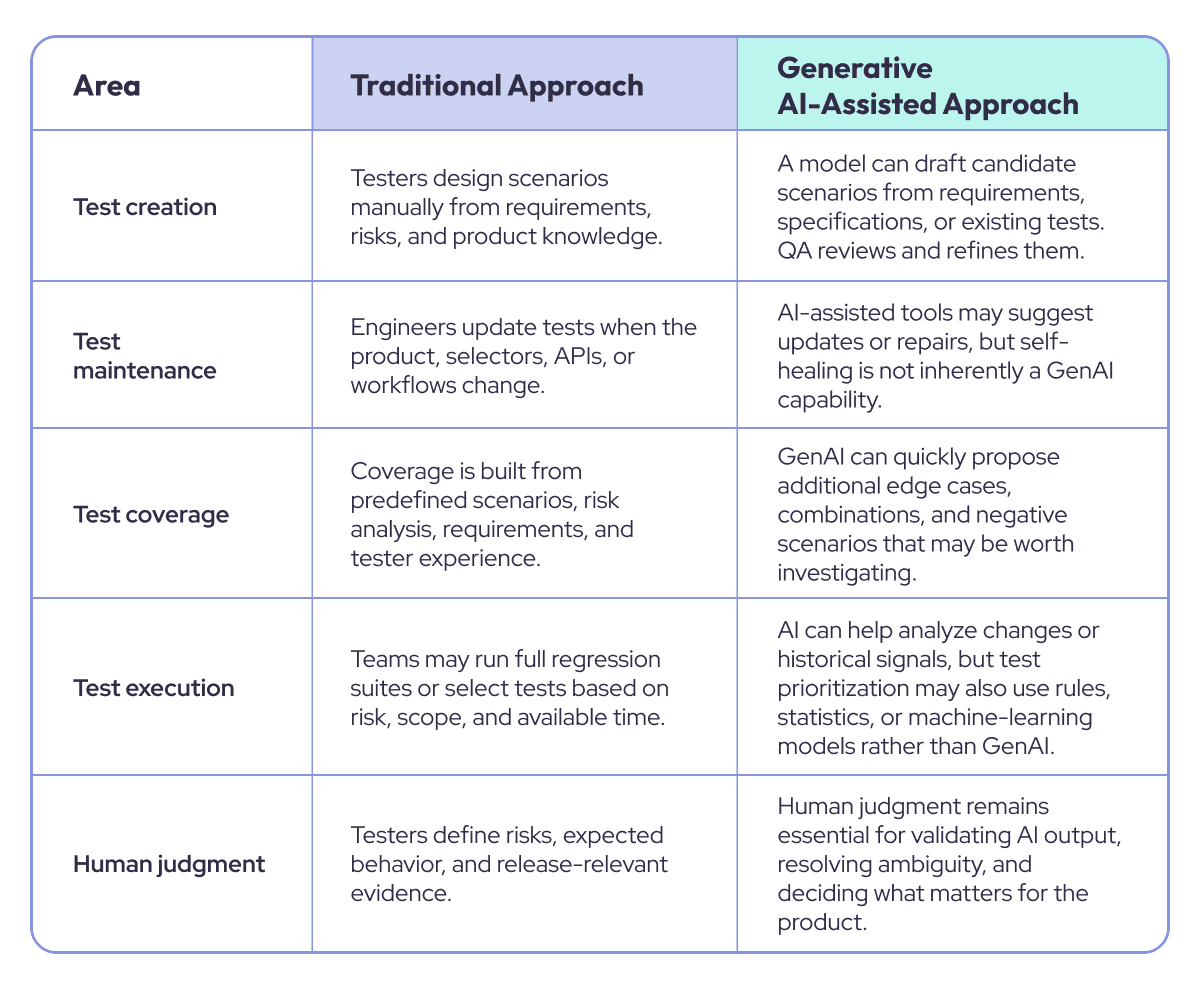
Generative AI vs. Traditional Software Testing
Generative AI changes how some testing activities are prepared and supported, but it does not replace the core principles of software testing.
Benefits of Generative AI in Software Testing
Generative AI can improve efficiency when it is applied to suitable tasks and its output remains reviewable.
- Faster test case creation: GenAI can turn requirements, user stories, and acceptance criteria into draft test scenarios that QA engineers refine instead of creating everything from scratch.
- Broader test ideas: Models can suggest negative cases, boundary conditions, unusual combinations, and alternative user flows that may not appear in the initial test set.
- Reduced repetitive preparation: AI can assist with drafting tests, creating data, summarizing failures, and producing documentation while leaving exploratory testing and judgment with QA engineers.
- Faster defect analysis and reporting: AI assistants can summarize logs, traces, screenshots, and other test evidence into clearer draft defect reports.
- Regression testing support: GenAI can help connect product changes with relevant requirements and existing tests, while prioritization may also rely on rules, historical data, or other machine-learning techniques.
- Faster CI/CD feedback: GenAI can summarize failures, classify results, and surface evidence sooner so QA engineers spend less time interpreting large volumes of output.
Risks and Limitations of Generative AI in Software Testing
The same capabilities that make GenAI useful can also introduce errors, privacy concerns, additional costs, and false confidence when outputs are not properly reviewed.
Hallucinated or Irrelevant Test Cases
A model may generate scenarios that are unsupported by requirements, technically impossible, or irrelevant to the product.
False Confidence From Unvalidated AI Outputs
Plausible-looking tests or explanations can still be wrong. AI-generated output should be treated as a candidate until it is reviewed and validated.
Data Privacy and Compliance Risks
Requirements, logs, production data, and customer information may contain sensitive data. Teams need to understand what is sent to the model, how it is processed, and how long it is retained.
Bias in AI-Generated Scenarios
Generated tests may reflect patterns or assumptions present in training data or supplied context, which can leave important user groups or scenarios underrepresented.
Infrastructure and Cost Limitations
Model usage can add latency, API costs, compute requirements, and dependency on external providers, especially at scale.
Workflow Integration Challenges
GenAI provides value only when its outputs fit existing test management, automation, CI/CD, review, and governance processes.
Over-Reliance on AI Without QA Expertise
AI can generate and analyze testing artifacts, but it does not independently understand product risk, business priorities, or acceptable behavior. QA expertise remains necessary to judge what should be tested and whether the evidence is trustworthy.
How to Validate AI-Generated Test Cases
AI-generated test cases should be treated as candidates, not automatically accepted tests. A structured review helps ensure that each case reflects real product behavior, relevant risks, and defined requirements.
Review Against Acceptance Criteria
Check whether each generated scenario is supported by the requirement, acceptance criteria, specification, or another authoritative product source.
Confirm the Feature and Preconditions Exist
Models may generate plausible scenarios for functionality, states, permissions, or integrations that the product does not actually support. Verify that the required feature and preconditions exist.
Validate Expected Results and Business Logic
Do not accept an expected result simply because it sounds reasonable. Confirm it against documented business rules or clarify ambiguous behavior with the responsible product or engineering team.
Remove Duplicate and Low-Value Tests
AI can produce several variations of essentially the same scenario. Remove duplicates and cases that add little meaningful coverage.
Require Human Review Before Approval
A QA engineer should review generated candidates before they become part of the maintained test suite, especially for high-risk or business-critical flows.
What Makes a QA Team Ready for Generative AI Testing?
Generative AI works best when it is added to a mature QA process with reliable requirements, automation, test data, and review practices.
Clear Requirements and Acceptance Criteria
AI-generated tests are only as useful as the context provided. Clear requirements reduce unsupported assumptions and make expected behavior easier to validate.
Reliable Element Identification and Locator Strategy
Stable locators reduce unnecessary maintenance and make AI-assisted test generation or repair more dependable.
Structured Test Repository
Requirements, test cases, reusable components, and automation assets should be organized so that relevant context can be found and reused consistently.
Secure Access to Test Data
AI tools should receive only the data they need. Teams must control access to sensitive information and understand how external providers process and retain submitted data.
QA Skills and AI Review Process
QA engineers need enough product and technical knowledge to challenge generated output, verify assumptions, and reject incorrect or low-value suggestions.
How to Implement Generative AI in Software Testing Step by Step
A practical implementation should move from controlled, low-risk use cases toward broader integration only after the team can validate quality, cost, and operational impact.
Step 1: Audit the Current QA Process
Measure where time and uncertainty exist today: test-design effort, regression duration, flaky tests, automation maintenance, defect triage, environment constraints, and test-data preparation. A QA audit can help identify weaknesses in an existing quality process before another technology layer is added.
Step 2: Identify High-Value AI Use Cases
Choose tasks where GenAI can provide clear assistance, such as test-case drafting, test-data generation, failure summarization, automation support, or exploratory-test ideation.
Step 3: Start With a Low-Risk Pilot
Test the approach on a limited feature or workflow where incorrect AI output will not affect critical release decisions or production systems.
Step 4: Prepare Requirements, Test Data, and Environments
Make sure the model receives reliable context and that generated tests or automation can be evaluated in a controlled environment.
Step 5: Choose the Right AI Testing Tools
Evaluate tools based on the actual QA task, integration requirements, security controls, data handling, and compatibility with the existing test stack.
Step 6: Define Review and Approval Workflows
Decide which AI outputs require human review, who approves them, and what evidence is needed before generated artifacts enter the maintained test suite.
Step 7: Integrate AI-Assisted Testing Into CI/CD
Add AI-assisted steps gradually, such as failure summarization or test generation, without allowing unvalidated model output to control critical release decisions.
Step 8: Measure Results Before Scaling
Track practical outcomes such as review effort, invalid outputs, maintenance time, execution cost, and whether AI-assisted workflows improve useful test coverage or feedback speed.
Step 9: Train QA Engineers to Review AI Outputs
QA teams need to recognize unsupported assumptions, weak assertions, hallucinated behavior, privacy risks, and technically plausible but incorrect suggestions.
Step 10: Scale Proven Workflows
Expand only the use cases that demonstrate consistent value. More advanced teams may introduce agentic testing for selected workflows where tool access, validation, and operational controls are mature enough to support it.
The goal is not to automate every QA activity with AI. It is to introduce GenAI where it improves the testing process without weakening control over expected behavior, evidence, or release risk.
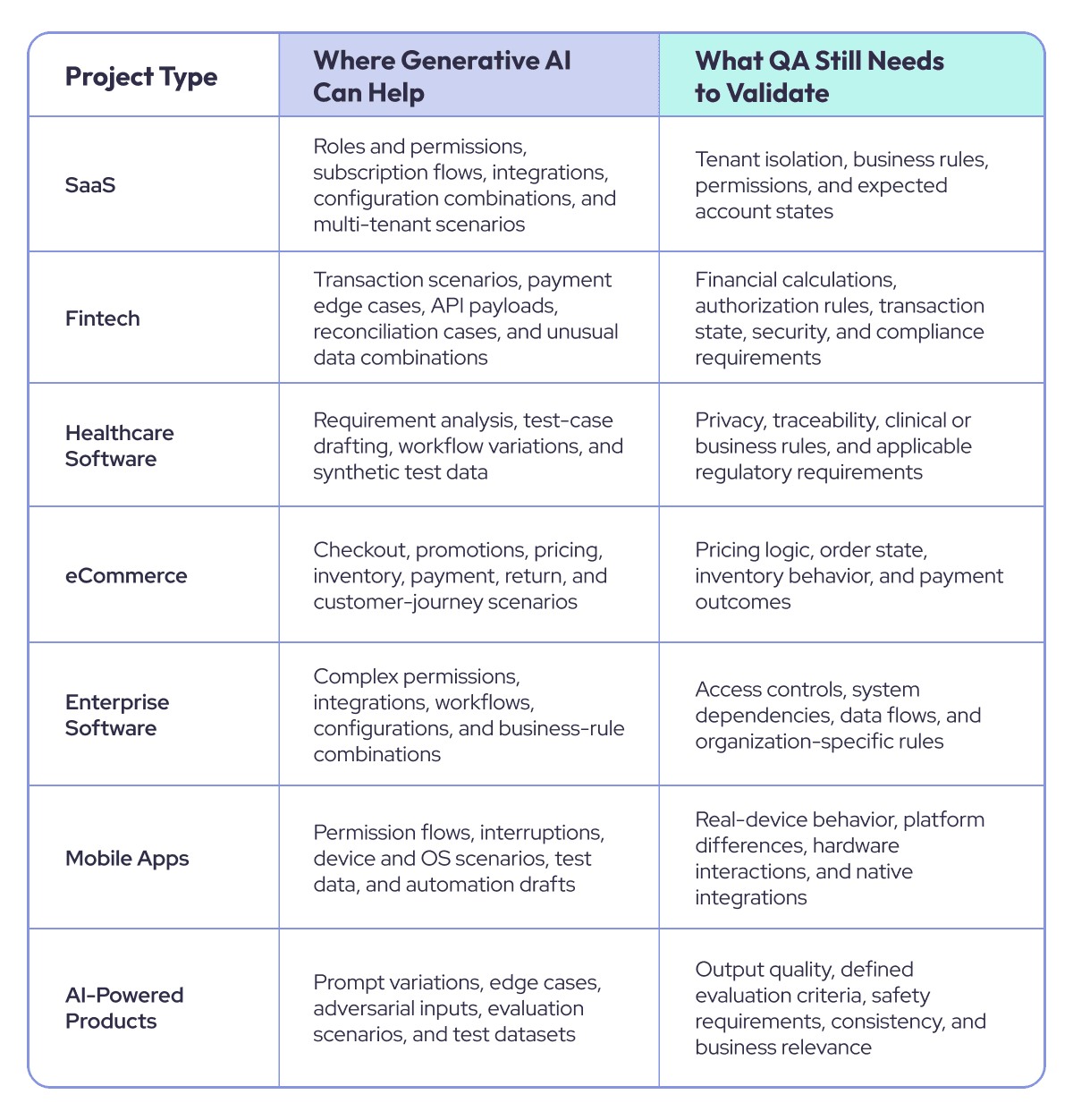
Best Generative AI Testing Use Cases by Project Type
The most useful generative AI testing use cases depend on the product, its architecture, data sensitivity, and business risks.
Generative AI Testing Tools: What Features to Look For
Choose a generative AI testing tool based on the workflow and the problem it must solve. Self-healing, visual testing, predictive analytics, and agentic workflows may rely on different techniques.
Test Case Generation From Requirements
Look for tools that can turn requirements, user stories, acceptance criteria, or specifications into structured candidate test cases. More important than the volume of generated tests is traceability. Reviewers should be able to connect a generated scenario to its source requirement, edit or reject it, and identify unsupported assumptions before it becomes part of the maintained test suite.
Natural-Language Test Authoring
Natural-language authoring allows testers to describe actions and expected behavior without manually writing every automation command. During evaluation, check how the tool handles assertions, reusable flows, variables, ambiguous instructions, unsupported actions, and later maintenance. Testers should still be able to inspect what the generated test executes and verifies.
Self-Healing Automation
Self-healing attempts to recover automated tests when locators, UI elements, or related application structures change. You should be able to see what changed and why, because an automatic repair can still hide a regression or an outdated assertion.
Synthetic Data Generation
Synthetic data generation can create normal, negative, boundary, locale-specific, and unusual inputs. Check whether the tool respects required formats, schemas, and domain constraints. Sensitive production data should not be sent to an AI service for test-data generation unless appropriate security, privacy, and data-handling controls are in place.
Visual Testing and Multimodal Validation
Visual and multimodal capabilities can use screenshots and UI context, but conventional visual regression and multimodal GenAI are not the same technology. Evaluate baseline management, dynamic-content handling, responsive layouts, cross-browser or cross-device comparison, and how detected differences can be reviewed and approved when necessary.
Security, Privacy, and Governance Controls
AI-assisted testing may process requirements, source code, screenshots, logs, and test data. Determine what leaves the organization, where it is processed, how long it is retained, who can access it, and whether it may be used for model training. Also review access controls, SSO, secret handling, data residency, auditability, deployment options, and controls for turning AI features on or off.
Reporting and Auditability
Reporting should preserve enough context to investigate results, such as the test version, environment, pipeline run, screenshots, logs, requirement, and defect. For AI-assisted testing, also check whether generated or modified artifacts can be identified and whether significant automated changes remain visible for later review.
Practical checklist: verify that the platform produces useful tests from realistic project inputs, fits the existing test automation and delivery stack, handles sensitive data appropriately, preserves enough evidence to investigate failures, and keeps important testing decisions reviewable by the team.
Governance, Security, and Compliance in AI-Assisted QA
AI-assisted testing can involve requirements, logs, test data, source code, and other sensitive assets. Governance should therefore cover what data models can access, how AI-generated outputs are reviewed, and how important actions remain traceable.
Protect Sensitive Data
Provide AI tools only with the data required for the task. Remove or mask credentials, personal data, production records, and other sensitive information where possible, and review how external providers process, retain, and use submitted data. Where the GDPR applies, its data-minimization principle requires personal data to be limited to what is necessary for the stated purpose.
Synthetic Data vs. Anonymized Production Data
Synthetic data is generated rather than copied directly from production, but it is not automatically anonymous or privacy-safe. NIST notes that synthetic data without appropriate privacy guarantees can remain vulnerable to privacy attacks. Under the GDPR, truly anonymized data is treated differently from pseudonymized data, which may still qualify as personal data.
Consider GDPR, HIPAA, and SOC 2 Separately
These frameworks are not interchangeable. GDPR governs the processing of personal data within its scope; the HIPAA Security Rule establishes safeguards for ePHI handled by regulated entities; and SOC 2 is an attestation examination based on AICPA Trust Services Criteria rather than a privacy law.
Apply Responsible AI Governance
QA teams should define ownership, review criteria, access controls, monitoring, and escalation paths for AI-assisted workflows. The NIST AI Risk Management Framework and its Generative AI Profile provide useful voluntary guidance for managing AI-related risks.
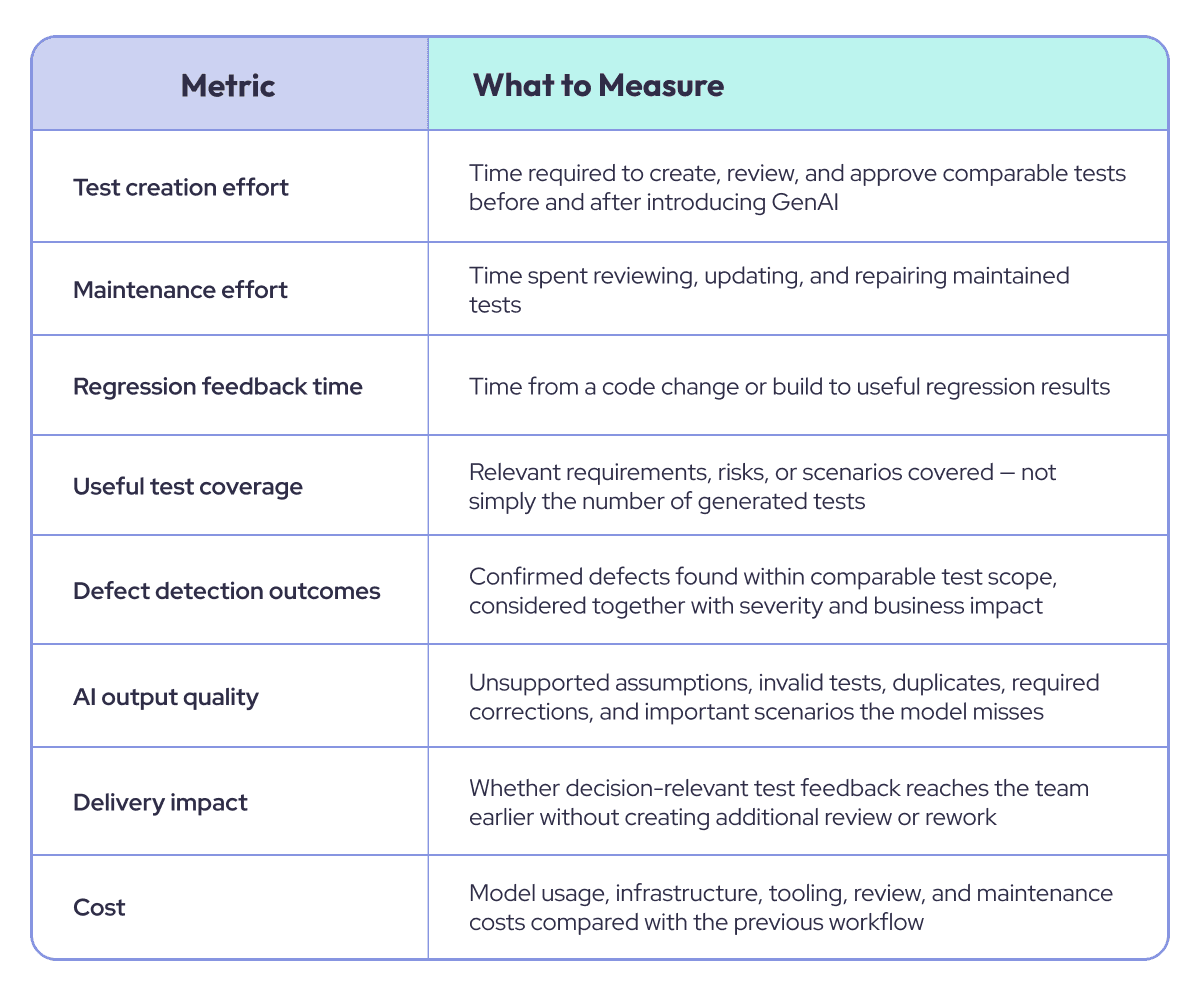
How to Measure the ROI of Generative AI in Software Testing
ROI should be measured against a defined baseline and should consider both efficiency gains and the quality of AI-assisted output.
Common Mistakes When Using Generative AI in Software Testing
GenAI introduces additional value only when generated output is supported by appropriate validation, test design, and data controls.
Starting Too Broadly
Begin with a limited, low-risk use case before expanding AI-assisted testing across the QA process.
Using Vague Requirements
Incomplete requirements can cause models to fill gaps with plausible but unsupported assumptions.
Adding Generated Tests Without Review
AI-generated scenarios, expected results, and automation should be validated before becoming part of the maintained test suite.
Ignoring Test Maintainability
GenAI does not remove underlying problems such as weak test architecture, poor isolation, unreliable test data, or brittle automation.
Ignoring Security and Compliance
Sensitive requirements, logs, source code, and test data should only be provided to AI services under appropriate data-handling, access, and governance controls.
Measuring Speed Without Quality
Measure how much of the generated output is valid and useful after review, not only how quickly it is produced.
The Future of Generative AI in Software Testing
Generative AI in testing is increasingly being combined with tools, execution, and feedback to support more complex QA workflows.
Agentic QA systems may assist with planning, generation, execution, evidence collection, and failure analysis. Other AI and machine-learning techniques can support regression prioritization and adaptive exploration, although these are not inherently generative AI. As more products include LLMs and other AI capabilities, QA teams may also need to evaluate variable outputs, consistency, safety constraints, and task-specific quality alongside conventional deterministic checks.
AI can support or automate more testing activities, but human judgment remains important for product context, expected behavior, risk, and release decisions.
How a QA Partner Can Help Implement Generative AI Testing
Introducing generative AI into testing requires more than choosing an AI tool. Teams need to identify where GenAI can add value, define how its outputs will be validated, and integrate it into existing QA workflows. A QA partner can support this process through:
- QA process audit and AI readiness assessment: Review current testing, automation, test data, and workflows to identify suitable GenAI use cases and existing gaps.
- Generative AI testing strategy: Define priority use cases, validation requirements, security constraints, ownership, and success criteria.
- Test automation modernization: Improve test structure, data management, reporting, and CI/CD integration so AI-assisted automation remains maintainable.
- AI tool selection and integration: Evaluate tools based on workflow fit, data handling, integrations, output quality, maintainability, and review requirements.
- Human-in-the-loop validation: Establish clear review and approval rules for AI-generated tests, code, summaries, and recommendations.
- Continuous evaluation: Compare AI-assisted workflows with the original baseline using metrics such as creation effort, review effort, maintenance cost, output quality, and defect detection outcomes.
Conclusion
Generative AI in software testing can accelerate test design, automation drafting, test data generation, and result analysis, but its outputs still require validation. Passing tests and larger test suites do not automatically guarantee meaningful coverage or correct business behavior. A reliable approach combines AI-assisted creation and analysis with established testing systems and human expertise. If you're implementing AI in your product or planning to do so and are unsure how it may affect software quality, contact us for QA expertise.
Comments
There are no comments yet. Be the first one to share your opinion!
For 8 years, we have helped more than 200+ companies to create a really high-quality product for the needs of customers.
- Quick Start
- Free Trial
- Top-Notch Technologies
- Hire One - Get A Full Team
Was this article helpful to you?
Looking for reliable Software Testing company?
Let's make a quality product! Tell us about your project, and we will prepare an individual solution.
Generative AI in software testing means using generative models to create or transform QA-related content such as test cases, automation drafts, test data, documentation, and failure summaries.
Generative AI is used in software testing to support tasks such as test case generation, test data creation, automation code drafting, failure analysis, and test result summarization. It can also help QA teams explore edge cases and derive candidate scenarios from requirements, but its outputs still need human validation before they are trusted or added to a production test suite.
AI can automate many routine tasks, but QAs are still necessary for creative tasks that require intuition and experience.
The main risks of AI-generated test cases are incorrect assumptions, missing business context, duplicated or low-value scenarios, weak coverage of important edge cases, and false confidence in test completeness. AI-generated cases may also reflect outdated requirements or produce plausible but invalid assertions, so they should be reviewed against current product logic, risk priorities, and expected business behavior before use.
AI-generated tests should be validated against current requirements, business rules, risk priorities, and expected system behavior. QA engineers should review the test logic, inputs, assertions, coverage, and potential duplication, then execute the tests in a controlled environment to confirm that they produce meaningful and repeatable results before adding them to the regular test suite.