Updated Jun 08, 2026 14 min read

AI Testing Trends in 2026
Get ahead of the curve with our breakdown of the top AI testing trends for 2026, from autonomous testing to validating AI-generated code. Find out how you can start preparing for AI-driven shifts.
Over the past two years, AI has become one of the most talked-about tools in QA. Whereas it used to be primarily used for generating test cases and documentation, today we are seeing the emergence of agent-based systems, self-healing automation, and risk analysis tools. However, the practical application of AI in testing still differs significantly from the marketing hype.
But “AI won’t replace testers. It is here to help testers who are ready to move forward.”Although this statement may sound confusing, its meaning is quite simple.
Instead of replacing testers, AI will become a powerful tool in their hands. The key is learning how to use it effectively.
According to industry statistics, the global AI‑enabled testing market size is projected to grow from USD 1.21 billion in 2026 to USD 4.64 billion by 2034, with a CAGR of 18.30%. That makes AI‑enabled testing one of the fastest‑growing areas in software quality assurance. Companies worldwide are investing in AI‑driven testing solutions to improve automation, reduce testing time, and increase the reliability of software products.
Is your business ready for AI? Cut through the noise with this guidance on AI testing trends 2026 and stay ahead of your competitors.
What Is AI in Software Testing?
Artificial intelligence in software testing involves the use of ML models and LLMs to automate test analysis, generate test scenarios, and detect anomalies in system behavior.
Instead of relying solely on predefined scripts, AI can process large datasets, detect patterns, and continuously adapt to changes in the software. This makes it ideal for tasks like:
- Generating test cases (e.g., using tools like ChatGPT with Playwright).
- Detecting anomalies and deviations from expected behavior.
- Simulating user behavior to identify bottlenecks and improve responsiveness.
Benefits of Using AI for Software Testing
The incorporation of AI in the software development process yields many benefits:
- Higher software quality: AI reduces human error and detects bugs early, leading to a more reliable end product.
- Cost efficiency: Automating repetitive tasks frees up QA engineers to focus on higher-value work, reducing labor costs and speeding up release cycles.
- Predictive analytics: AI can anticipate potential failures by analyzing historical data, enabling proactive risk mitigation.
But even with all these benefits, one truth remains: AI makes mistakes. Today, AI can plan test strategies, analyze failures, and improve itself, all autonomously. But humans remain at the core of product quality. Quality doesn't come from automated scripts. It's created by people who use AI to think better, not less.
If you're already implementing AI in your product or just planning to and are unsure how it will impact its quality, contact us for QA expertise. Find out more about our AI testing services.
AI in Software Testing 2026 Trends
AI testing trends are rapidly reshaping the future of quality assurance, helping teams improve automation efficiency, accelerate releases, and build more reliable software products. Let’s take a look at the AI testing trends shaping the future of software quality in 2026. You can also explore our guide about test automation trends to look out for in 2026.
AI in Software Testing 2026 Trends: AI-Driven Test Automation
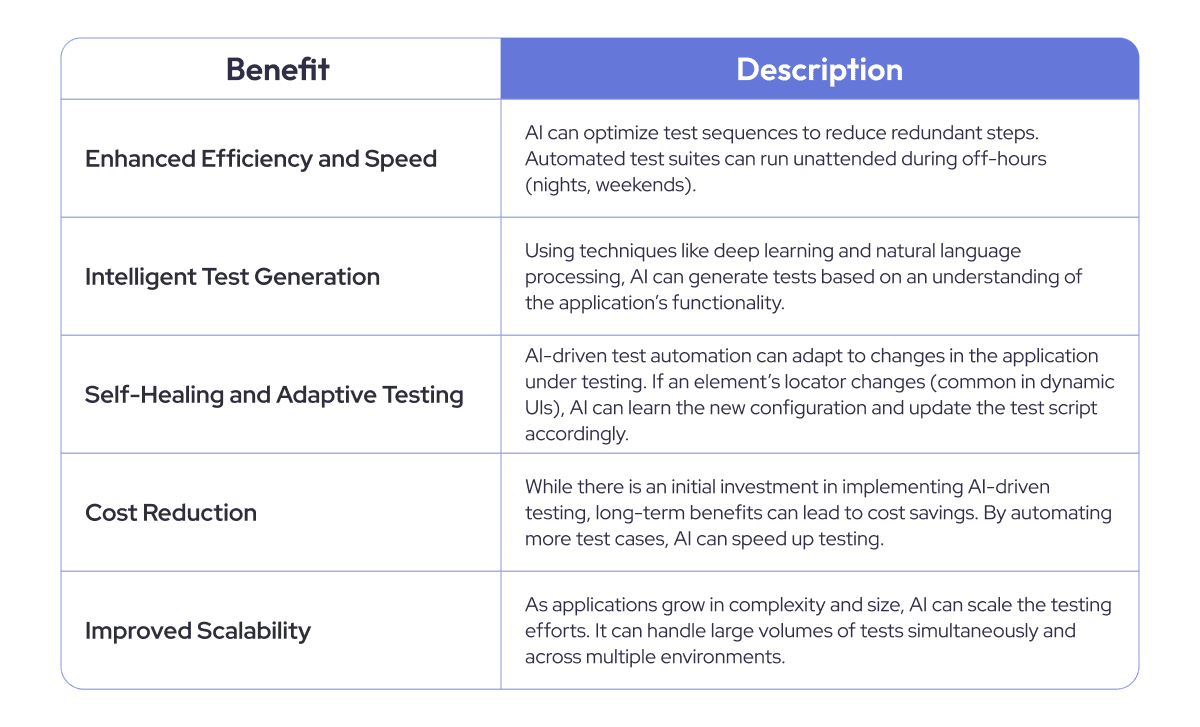
AI is rewriting the rules of test automation. Today’s AI tools can optimize test execution and even self-heal broken scripts, all with minimal human intervention. This shift from manual to AI-driven automation is making testing more scalable and less time-consuming.
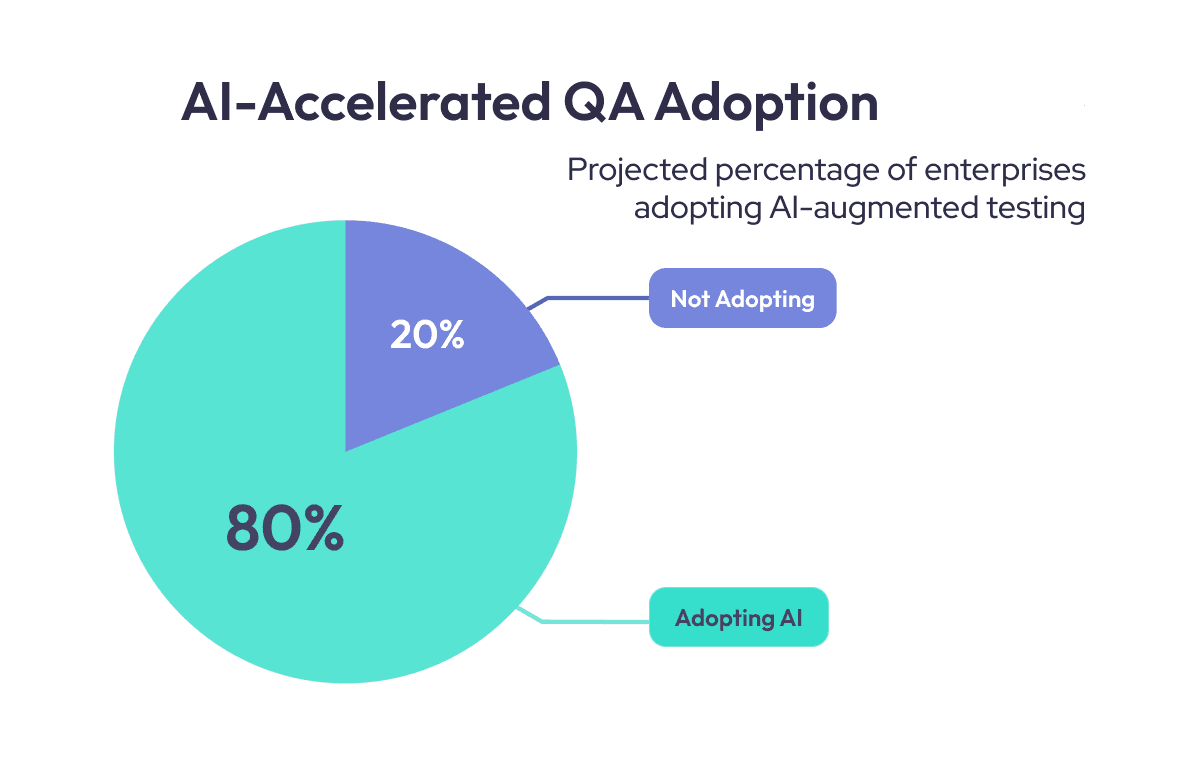
Integrating AI into test automation offers several significant benefits:
Autonomous AI Agents and Agentic Testing
Agentic testing leverages autonomous AI agents to independently plan, execute, and adapt software tests without relying on rigid, human-coded scripts.
Instead of following fixed steps, these agents use natural language understanding, reasoning, and computer vision to perceive application changes, navigate user interfaces, detect UI elements dynamically, and adjust testing strategies in real time. How it works in practice:
- An agent receives a user story or requirement in natural language.
- It creates end-to-end test scenarios, including edge cases.
- It runs tests across environments and self-heals broken locators.
- It provides root-cause analysis with explanations.
This trend marks a shift from "AI-assisted" to "AI-driven" testing. Instead of using AI merely as a supporting tool, autonomous agents take the lead in planning and executing tests, while humans focus on strategy, oversight, and complex decision-making.
AI for Test Case Generation
AI test case generation refers to the use of artificial intelligence by interacting with a large language model (LLM) through natural language to automatically produce test cases based on structured inputs. This speeds up test creation and ensures broader coverage of possible inputs and edge cases. For example, instead of writing scenarios from scratch, teams can use AI to:
- Generate test cases from multiple document types and sources, including JIRA, Word, Excel, PDFs, plain text, Figma, etc.
- Produce ready-to-use test steps, preconditions, input data, and expected results.
- Create both positive (happy path) and negative (edge case) scenarios that might otherwise be overlooked.
- Fill in test coverage gaps based on past patterns or risk areas.
Test Code Generation
Chat GPT and other LLMs (Large Language Models) can generate test code for you. Paired with developer-integrated environments (DIE) tools such as GitHub Copilot, they can:
- Generate test code from simple comments in your IDE
- Create complete automated test scripts from provided test inputs or scenarios
- Suggest code improvements and refactor existing tests for better maintainability
Code Explanation
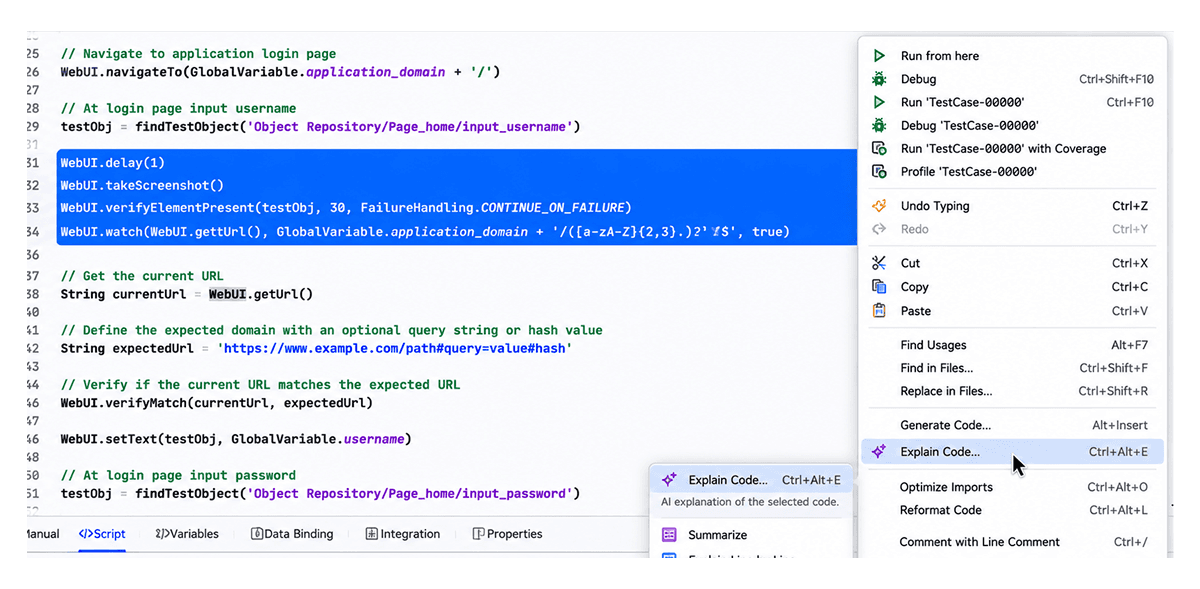
AI for code explanation is the capability of artificial intelligence to analyze and clearly explain existing code in natural language. It helps quickly understand complex or unfamiliar code by generating summaries, breaking down logic, highlighting key functions, and pointing out potential issues or improvements.
One standout AI feature we’ve seen (so far) only in Katalon: simply highlighting any section or line of code and right-clicking on it and selecting StudioAssist -> Explain Code (screenshot below).
Advanced Visual and Cognitive Testing
Visual testing, which involves checking the UI for consistency and correctness, is being enhanced by AI and computer vision. Cognitive testing, another trend, uses AI to simulate human-like interactions with applications. Some benefits of advanced visual and cognitive testing with AI:
- Faster detection of UI inconsistencies and usability issues
- Improved visual accuracy across devices and platforms
- Enhanced user experience validation through AI-driven analysis
AI for Usability Testing
AI + usability helps create intuitive, user-friendly products that your users enjoy using and often choose over competitors.
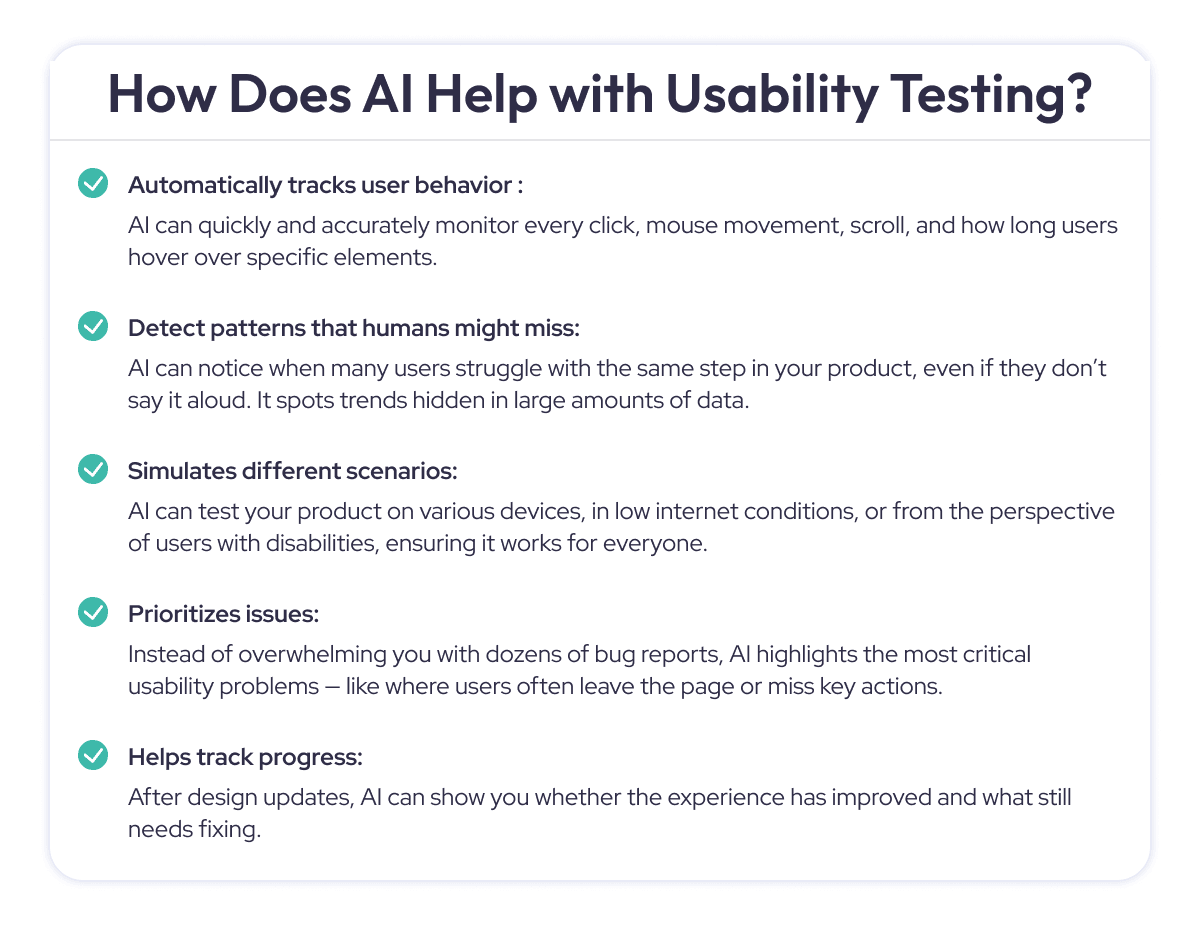
In 2026, AI-powered usability testing enables QA teams to validate the user experience much earlier and more frequently in the development cycle.
Ethical AI & Bias Testing
Ethical AI & bias testing is the practice of systematically evaluating AI systems for fairness, transparency, and ethical compliance. It focuses on identifying and mitigating biases that can lead to discriminatory or unfair outcomes. Some benefits:
- Companies with AI ethics audits → 2× ROI vs those without
- Potential AI ethics value: $15 trillion by 2030
- Only 20% of executives report alignment between ethics practices & stated principles
Integration with DevOps and CI/CD Pipelines
Automated AI-driven tests are being embedded in CI/CD pipelines to provide immediate feedback on code changes. This shift-left testing approach means issues are caught earlier in the development lifecycle. Whay about benefits?
- Faster feedback loops: Issues are detected right after code commits, reducing the time between development and validation.
- Early defect detection (shift-left testing): Bugs are identified at the earliest stages of the SDLC, making them significantly cheaper and easier to fix.
- Improved release speed: Continuous testing reduces bottlenecks in QA and supports faster, more frequent deployments.
The future of testing isn't about choosing between human intelligence and artificial intelligence. It's about combining both to achieve quality at a scale and speed we've never seen before.
Keep your software a step ahead with Luxe Quality. Our software testing solutions help you optimize QA processes, detect issues before they reach users, and get the most out of your budget.
What AI in QA Still Cannot Do (Despite Marketing Claims)
Despite the hype, AI in QA still cannot replace human judgment, provide reliability in complex systems, or fully address governance and ethical risks. In 2026, the biggest limitations are hallucinated test assertions, flaky automation, lack of contextual reasoning, and the inability to ensure trust without human oversight. What AI in QA still cannot do:
- Autonomously test complex business workflows end-to-end
- Understand business rules and system states without explicit context
- Replace human judgment on whether a product is genuinely fit for purpose
- Test non-deterministic AI systems reliably using conventional pass/fail logic
What's Coming Next
- Self-healing tests: storing business context alongside UI locators so vision models can reidentify changed elements and auto-update test scripts without manual intervention.
- Framework generation: AI builds UI automation libraries for new or updated applications automatically, replacing hand-crafted object repositories.
- Agentic testing platforms: tools designed specifically to test AI systems themselves, not just use AI for testing.
While AI can automate repetitive tasks, it cannot replace critical thinking, creativity, and contextual awareness of human QA engineers. Instead, AI should be seen as a tool to enhance their capabilities, allowing them to focus on more strategic and complex challenges.
AI Is Different. QA Should Be Too.
AI-based software differs significantly from traditional applications. While traditional software follows rule-based logic, AI systems are often dynamic and learn from data, making predictions and decisions based on patterns. This unpredictability introduces a need for specialized testing strategies to ensure:
- Accuracy: Verifying that AI systems produce correct and reliable results.
- Bias detection: Ensuring AI does not make unfair or discriminatory decisions
- Ethical considerations: Ensuring the AI behaves in accordance with ethical standards.
Testing Approaches for AI-Based Products
There are three key approaches for testing AI applications, each focusing on a different aspect of the AI lifecycle:
- Data-centric testing: Focuses on testing the raw data used to train AI models.
- Model-centric testing: Focuses on the performance of the AI model itself.
- Deployment-centric testing: Focuses on testing the AI in a live environment.
Can AI Really Replace Manual Testing?
Automation testing cannot exist without manual testing. While AI is transforming software testing by automating repetitive tasks, increasing speed, and providing self-healing test capabilities, it lacks the human intuition, creativity, and contextual understanding necessary for holistic product quality.
AI can generate thousands of test cases. But it doesn’t understand:
- hesitation
- confusion
- trust
The current shift in the industry emphasizes several key reasons why human testers remain indispensable:
- AI is viewed as a thoughtful assistant rather than a replacement. It can handle routine, repetitive tasks such as generating test case drafts or providing predictive quality insight. This frees up human testers to focus on high-stakes analysis and creative strategy.
- Relying solely on AI without human oversight is dangerous. AI can produce what is termed "AI slop"-results that appear structured and correct but lack real meaning, context, or business value. Because AI can "hallucinate" or invent non-existent results, every AI-generated output must be verified by a human with the experience to spot errors.
- Even without full automation, manual testing can be made significantly more efficient through smart integrations, workflow optimizations, and AI-powered test management platforms.
Ultimately, the most effective approach is a Human + AI partnership. AI provides an "unreliable booster" to productivity, but real product quality is still created by people who use AI to think better, not less.
Conclusion
The AI software testing trends 2026 mark a profound transformation in software quality assurance, moving from traditional, manual processes to intelligent, adaptive, and autonomous systems. Companies that embrace AI are already outperforming their competitors.
We believe that the real value comes from treating AI as a smart and helpful assistant, rather than expecting it to be a magic solution. The future of quality assurance is intelligent, autonomous, and human-augmented.
Comments
There are no comments yet. Be the first one to share your opinion!
For 8 years, we have helped more than 200+ companies to create a really high-quality product for the needs of customers.
- Quick Start
- Free Trial
- Top-Notch Technologies
- Hire One - Get A Full Team
Was this article helpful to you?
Looking for reliable Software Testing company?
Let's make a quality product! Tell us about your project, and we will prepare an individual solution.
FAQ
The main AI software testing trends 2026 include autonomous testing agents, AI-driven test automation, AI-generated test cases, ethical AI validation, and AI-powered usability testing.
AI is useful for automating repetitive tasks, but it does not have the critical thinking, creativity, or understanding of context that human QA engineers bring. Instead, AI should be seen as a tool that enhances their abilities, allowing them to focus on more strategic and complex work.
Common challenges include AI hallucinations, lack of explainability, data quality issues, integration complexity, and the need for human oversight.
AI can automatically generate test cases based on requirements and application behavior. However, human oversight remains essential to eliminate inaccuracies and ensure it reflects the project's needs.
It can. But is your organization willing to invest the upfront time and discipline required to deploy it thoughtfully rather than just chasing headlines? AI won’t catch what it doesn’t know to look for. That’s why you need us. Partner with our team of professionals and experience software quality that keeps you ahead of the competition.