Updated Jan 28, 2026 15 min read

Top AI Testing Companies: Your Ultimate Guide
In this ultimate guide, we have listed the top AI testing companies based on their market track record, experience with AI in Software Testing, project success rate & client feedback.
The contemporary business environment is defined by high rates of technological development, global competition, and an increased emphasis on data-driven decision-making.
Artificial intelligence (AI) is among the innovations that have significantly transformed this landscape. Predictive analytics, natural language processing, automation, and customer personalization, along with other AI technologies, have transformed the operations and value creation of organizations. AI is now driving efficiency, customer engagement, and innovation across almost all industries. As industries adopt a digital-first approach, AI integration is now a significant factor in competitiveness and long-term success.
AI in software testing is projected to grow by 37.3% from 2023 to 2030, reflecting increasing reliance on intelligent tools for quality assurance.
In this ultimate guide, we have listed the top AI testing companies based on their market track record, experience with AI in software testing, project success rate & client feedback.
Key Capabilities of AI Software Testing
"AI won't replace testers, but it will replace those who don't use AI," is a popular saying in the tech world. And yes, AI requires supervision and human intervention to ensure accuracy and effectiveness. QAs must monitor and correct the AI.
Key capabilities of AI software testing include:
- Intelligent test case generation
- Self-healing automation scripts
- Predictive defect detection
- Visual testing powered by computer vision
- LLM testing and prompt validation
- Smart test coverage optimization
Modern AI software testing companies integrate these capabilities into existing QA processes. While the initial costs of implementing AI can be high, in the long run, it can save money by increasing efficiency and reducing errors.
Why Businesses Are Turning to AI Testing Companies in 2026
The demand for AI-powered QA continues to grow for several reasons:
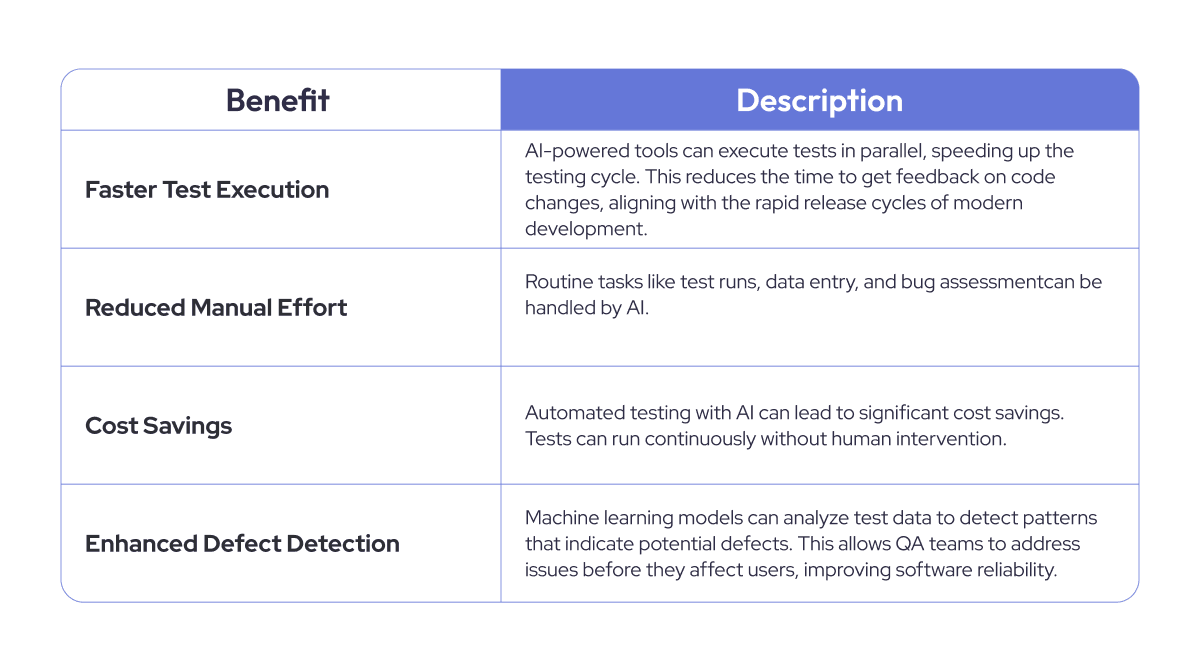
These factors explain why the market for top AI software testing companies in 2026 is expanding rapidly across the US and global markets.
Key Considerations for Choosing AI Testing Companies
With so many companies out there, how do you know who’s actually good? Here’s what we recommend keeping in mind:
Evaluate Experience and Expertise
Look for the best quality assurance companies that offer AI-powered testing solutions, with a proven track record in your industry. Review their case studies and success stories. A company with deep industry knowledge and technical expertise will be better equipped to handle your unique project challenges.
Customisation Options
Select the AI-based software testing provider that follows a strategic approach to balance efficiency, cost-effectiveness, and technology. In 2026, companies are actively seeking the top AI software testing companies to deliver scalable, intelligent, and reliable testing solutions.
Don’t Base Your Decision Solely on Price
While cost is essential, it shouldn’t be the deciding factor. Focus on value and the long-term impact of choosing the right partner. A reputable testing company will provide transparency in its pricing and offer flexible models that best suit your project’s needs.
Reputation And Client Reviews
Check online reviews on platforms like Clutch and Glassdoor. Don’t hesitate to contact previous clients for firsthand feedback. This will give you insights into their reliability, communication, and problem-solving abilities.
Technological Capabilities
Ensure the company uses modern tools and methodologies. They should be proficient in manual and automated testing, as each approach serves a specific purpose. Certifications and continuous training programs also indicate their commitment to staying ahead of industry trends.
Request Proposals and Conduct Interviews
Once you’ve shortlisted potential partners from the AI-powered software testing companies list, request detailed proposals outlining their approach, timelines, and costs. Conduct interviews to assess their understanding of your needs and ability to address potential challenges.
Make the Final Decision
Review all the information you’ve gathered, negotiate terms, and ensure the contract clearly outlines the scope of work, deliverables, and timelines. A long-term partnership with reliable AI testing companies can make all the difference in delivering a high-quality product.
Choosing among the best AI software testing companies in 2026 is a strategic decision that can significantly impact your product’s success. By following these steps, you can find a partner that meets your testing needs and aligns with your business goals.
At Luxe Quality, we understand the complexities of AI-driven software testing and offer expert services tailored to your business requirements. Contact us for further assistance or consultation.
Top AI Testing Companies In The USA And Globally
Below is a curated overview of the top AI Testing Companies in USA and globally. This is not a ranking, but a practical comparison. If you’re comparing vendors or building your QA strategy step by step, exploring related guides can help you make more informed decisions. For regional insights, you may want to review Software Testing Companies in UK and Best Software Testing Companies in USA to understand how QA providers differ across markets.
Luxe Quality
- Location: USA
- Founded: 2016
- Number of employees: 80+
- Awards: Luxe Quality has maintained a 5-star rating on Clutch and received various client accolades for their high standards and quality assurance practices.
- Website: luxequality.com
Overview
Luxe Quality is a top-rated software testing company that blends deep quality assurance expertise with modern AI-enabled testing practices to help businesses optimize and scale their QA processes. From pilot projects to in-depth testing, Luxe Quality helps streamline development by optimizing and scaling QA processes, ensuring the product meets business goals. By leveraging AI-driven automation, advanced LLM testing, and extensive mobile testing expertise across modern platforms, Luxe Quality helps organizations reduce risk, attract users, and maximize product value.
Core Services
Artificial intelligence (AI) testing, test automation (end-to-end, regression, smoke, performance, API, security, data-driven, integration, cross-browser, continuous testing, and automated test code review), manual testing (acceptance, regression, smoke, exploratory, functional, usability, compatibility, localization, and performance testing), QA audit and testing architecture.
Industries Served
Luxe Quality’s AI for software testing provides services to clients worldwide across industries such as fintech, healthcare, e-commerce, marketplaces, marketing, software development, business solutions, SaaS, insurance, real estate, edtech, and startups.
Cigniti
- Location: USA
- Founded: 1998
- Number of employees: 4200+
Overview
Cigniti is a global AI software testing company with a proven track record of delivering high-quality testing services to clients across various industries. Cigniti helps organizations achieve software quality objectives by focusing on innovation and continuous improvement.
Core Services
Quality engineering, digital assurance, advisory and transformation, digital engineering services, enterprise application assurance, test management services, outsourcing, IP, and innovation platforms.
Industries Served
Various industries, including medical devices, healthcare, life sciences, manufacturing, communication, energy & utilities, banking, insurance, retail, financial services, logistics, eCommerce, media & entertainment, travel & hospitality, airlines, consumer goods & distribution, automotive, technology, government, and education.
QASource
- Location: USA
- Founded: 2000
- Number of employees:1400+
Overview
QASource is a leader in software testing using artificial intelligence, as evidenced by ratings and reviews. The QASource team of experienced professionals focuses on streamlining AI and ML in software testing to improve efficiency.
Core Services
API testing, artificial intelligence testing, blockchain testing, cloud-based application testing, load and performance testing, manual testing, mobile app testing, QA consulting and analysis, Salesforce testing, security testing, AI services, and test automation.
Industries Served
QASource’s AI for software testing provides services to clients worldwide, spanning industries such as e-commerce, healthcare, finance, cybersecurity, legal engineering, banking, retail, media, e-learning, and trading.
Parasoft
- Location: USA
- Founded: 1987
- Number of employees: 500 +
Overview
Parasoft is a well-established software testing and quality engineering company specializing in automated and continuous testing, as well as software quality solutions for complex, regulated environments. With decades of experience, Parasoft is widely recognized for helping organizations improve software reliability, security, and compliance through advanced automation and AI-assisted testing technologies.
Core Services
Automated software testing, continuous testing & CI/CD integration, API testing, application security testing, compliance & regulatory testing, static and dynamic code analysis, AI-assisted test optimization.
Industries Served
Automotive, aerospace & defense, financial services, healthcare, telecommunications, industrial & embedded systems, government & public sector.
Testlio
- Location: USA
- Founded: 2012
- Number of employees: 190+ full-time employees
Overview
Testlio brings together a global network of experts, AI-powered solutions, an advanced testing platform, and seamless DevOps integrations to provide scalable, high-impact software testing. Trusted by the world’s biggest companies and most innovative brands, they help the clients release products faster and with confidence.
Core Services
AI-powered fused software testing, global crowd testing, localization testing, DevOps & CI/CD integration, distributed device network, payment testing, usability testing.
Industries Served
E-commerce & retail, finance & banking, health & wellness, media & entertainment, learning & education, mobility & travel, software & services.
TestingXperts
- Location: USA
- Founded: 2013
- Number of employees: 1,500+
Overview
TestingXperts is a global software testing and quality engineering company delivering automation-driven and AI-enabled QA services. The company supports enterprises with functional, performance, security, and continuous testing across complex digital ecosystems, helping improve quality, speed, and delivery efficiency.
Core Services
End-to-end product testing, functional testing, test automation, web & mobile testing, performance testing, security testing, usability testing, accessibility testing, environment and data management, and data testing & analytics.
Industries Served
TestingXperts caters to clients from various industries, including banking and finance, capital markets, insurance, telecom, healthcare, pharma, retail & consumer goods, media & entertainment, technology, energy, utilities, medical devices, credit unions, education, government, aerospace & defense, fashion, gaming, automotive, legal, and the UK public sector.
BugRaptors
- Location: USA
- Founded: 2016
- Number of employees: 300+
Overview
BugRaptors specializes in “Future-Ready Testing Services” with explicit AI & ML testing capabilities alongside blockchain, IoT, and big data testing. The company’s skilled team of testers ensures the delivery of high-quality software products to clients. Further, it allows clients to choose the most cost-effective option without compromising quality.
Core Services
Core QA services, quality engineering services, next-gen testing, and test consultation.
Industries Served
Healthcare, telecommunication, retail and commerce, energy and utility, transportation and logistics, manufacturing, education, banking and finance, insurance, real estate, travel and hospitality, food and beverages, pharma, media and entertainment, and government.
Indium Software
- Location: USA
- Founded: 1999
- Number of employees: 5,000
Overview
An AI-driven digital engineering company since 1999, now employing 1,000-5,000 specialists. They integrate artificial intelligence methods throughout their testing processes and offer AI-enhanced testing frameworks as part of their comprehensive quality engineering services.
Core Services
AI-powered quality engineering, test automation & continuous testing, performance testing, security & compliance testing, web & mobile application testing, test data management, DevOps & continuous testing integration, user acceptance testing, localization testing, IoT & embedded testing, LLM and AI testing services.
Industries Served
BFSI, healthcare, technology, retail, manufacturing, gaming.
Impact QA
- Location: USA
- Founded: 2011
- Number of employees: 250+
Overview
Impact QA is a global software testing company known for its expertise in using AI for software testing. Early specialization in generative AI and large language model testing positions them at the forefront of emerging AI technologies. Impact QA is a trusted partner for businesses across various industries.
Core Services
Functional testing, performance testing, test automation, mobile app testing, security testing, usability testing, compatibility testing, cloud testing, regression testing, API testing, accessibility testing, and IoT testing.
Industries Served
E-learning, retail and e-commerce, healthcare, BFSI, airline, media and telecom, logistics, real estate, energy and utilities, manufacturing, and travel and hospitality.
QA Mentor
- Location: USA
- Founded: 2010
- Number of employees: 400+
Overview
A CMMI Level 3 and multi-ISO certified company offers comprehensive AI-enabled testing services, including AI Test Framework, AI Test Lab, and specialized AI testing methodologies. QA Mentor operates a global delivery model, employing 400+ QA professionals across North America, Europe, and Asia. The company serves a broad client base, from startups to Fortune 500 enterprises, and supports applications across web, mobile, desktop, and enterprise platforms.
Core Services
Test design & execution on demand, mobile and browser compatibility testing, QA audit and process improvement, automation testing and QA automation, load, stress, and performance testing, security and penetration testing, regression testing factory, crowdsourced testing, QA eLearning, and corporate training.
Industries Served
Finance and banking, healthcare, eLearning, eCommerce, gaming, media and entertainment, mobile and wireless, social media web 2.0, and travel and leisure.
Our Case Studies: Smart Solutions With AI
At Luxe Quality, we understand the complexity of AI applications and the critical importance of thorough testing for their success. We leverage industry knowledge to tailor testing strategies for each application, aiming to improve user experience and customer satisfaction.
Read more about our testing solutions in case studies.
Case Study: AI Content Navigator (EU)
The platform was designed to transform how individuals consume and interact with digital content. By leveraging AI, this platform enables users to explore trending topics, generate personalized news summaries, and engage with content via text, voice, or images.
Features of the project:
- Incorporation of artificial intelligence for news generation and handling multiple input channels (text, voice, image).
- Ensuring cross-browser compatibility and responsive design for a consistent user experience across various devices.
Results:
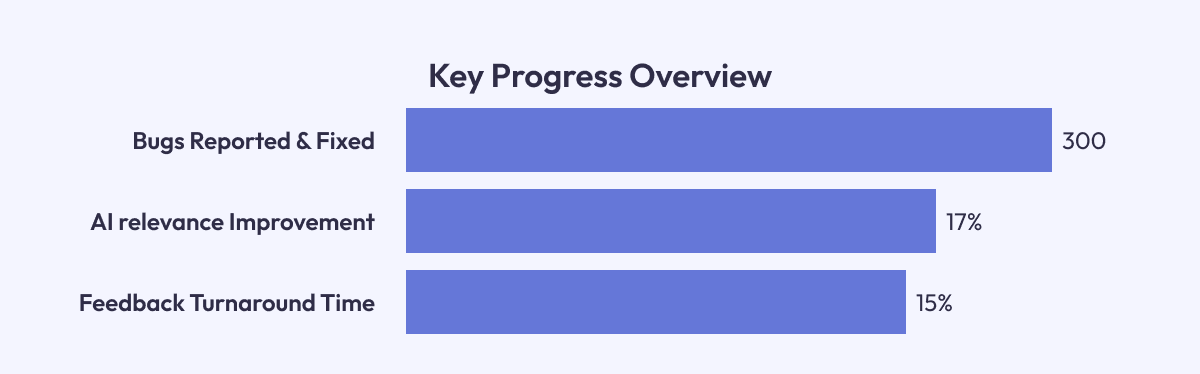
- Up to 300 bugs were reported and fixed, covering issues across functionality, layout, and AI response accuracy.
- Relevance of AI responses across different input types (text, voice, image) improved by 17%.
- A new defect-reporting format was introduced, resulting in an up to 15% improvement in feedback turnaround time.
Case Study: EdTech AI Platform (EU)
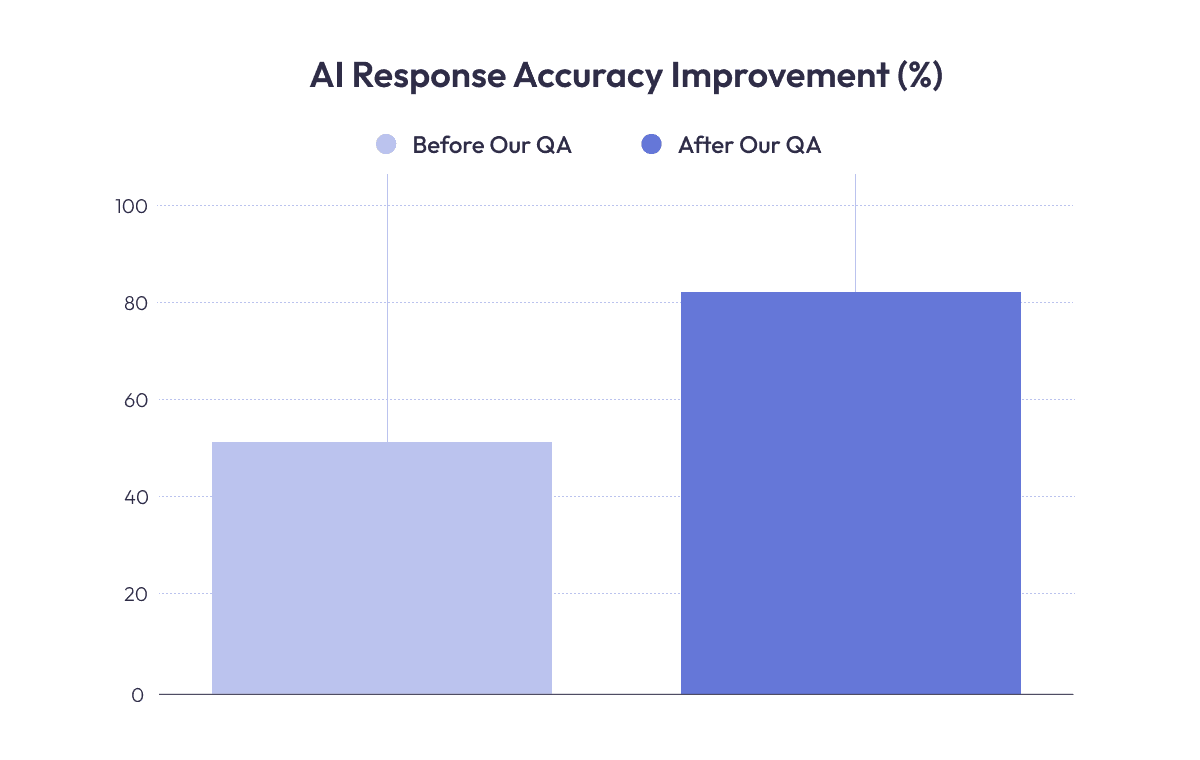
Before our QA joined the project, the AI system was tested only by developers. There was no test documentation. There was a strong need to validate the consistency of AI output in the UI layer and ensure it aligned with structured logic.
Features of the project:
- AI-driven logic for structured input processing and personalized recommendations.
- Controlled input flow: restriction on invalid or unstructured data.
- Integration of the frontend UI with AI modules in real time.
Results:
- Introduced a new bug report format that increased team alignment and issue resolution speed.
- Improved usability of the user interface.
- AI response accuracy improved.
Choosing Luxe Quality means partnering with a professional team that has extensive experience. We are committed to delivering reliable and efficient testing services to ensure your software thrives in a competitive market.
Challenges and Limitations of AI in QA
While AI offers many advantages, it also comes with challenges and limitations that QA teams must be aware of:
- Initial Setup and Complexity: Implementing AI in testing can be complex. Setting up AI models or tools requires data preparation, configuration, and often a certain level of technical expertise.
- Interpretability of AI Decisions: AI systems, especially deep learning models, can make decisions that are hard to interpret.
- Over-Reliance and False Positives/Negatives: If not carefully validated, AI can produce false positives (flagging something as a defect when it’s not) or false negatives (missing a real defect).
- Continuous Maintenance: AI tools often need regular maintenance and updates to function effectively.
To strengthen internal processes, we recommend reading how to improve QA testing process, along with practical articles on how to use AI in software testing and how to use AI in test automation.
.
Best Practices for Implementing AI in QA
To successfully integrate AI into QA, consider the following best practices:
Start with Clear Goals: Define what you want to achieve with AI in QA. Whether you aim to reduce test execution time or improve defect detection, having clear objectives will guide your implementation.
Use a Hybrid Approach: Avoid relying solely on AI automation or manual testing. Instead, adopt a hybrid model in which AI handles repetitive or data-intensive tasks, while humans handle creative and judgment-based aspects.
Focus on High-Value Use Cases: Identify which testing tasks will benefit most from AI. Start with high-impact areas like automating large test suites, predicting defects, or handling visual testing.
Ensure Data Quality and Diversity: Invest in high-quality test data to train and validate AI models. Regularly update and expand your test data to keep the AI models relevant.
AI is transforming QA in significant ways. Those who embrace these technologies and integrate them thoughtfully into their testing workflows will gain a competitive edge in delivering high-quality software more quickly.
Conclusion
Whether partnering with one of the leading service providers or implementing a cutting-edge platform from the tool vendors, the goal is the same: to augment human intelligence with machine efficiency. The journey to find the right solution begins with a thorough evaluation of your product's specific needs and long-term goals. The AI software testing companies list and AI test automation companies list highlighted in this guide represent the vanguard of this transformation, offering a glimpse into a future where software quality is not just tested, but intelligently assured.
By carefully selecting from the best AI software testing companies 2026, organizations can turn quality from a bottleneck into a competitive advantage. Keep your software a step ahead with Luxe Quality. Our AI software testing solutions help you optimize QA processes, detect issues before they reach users, and get the most out of your budget.
Comments
There are no comments yet. Be the first one to share your opinion!
For 8 years, we have helped more than 200+ companies to create a really high-quality product for the needs of customers.
- Quick Start
- Free Trial
- Top-Notch Technologies
- Hire One - Get A Full Team
Was this article helpful to you?
Looking for reliable Software Testing company?
Let's make a quality product! Tell us about your project, and we will prepare an individual solution.
FAQ
The ethical considerations of using AI in software testing include data privacy, bias in data models, and a lack of transparency in decision-making.
AI testing budgets vary significantly based on system complexity, industry requirements, testing scope, and engagement model. Contact us today. We will provide you wth all the necessary information. Our AI software testing solutions help you optimize QA processes, maximize profit within the same budget, and uncover defects before they impact users. Startups may benefit from our tailored software testing services for startups, while companies looking to outsource QA can follow our guide on how to choose a company to outsource software testing projects.
AI testing does not entirely replace manual testing. Exploratory testing, usability validation, and complex business logic still require human judgment. AI complements manual efforts by handling repetitive, data-intensive tasks and enabling testers to focus on higher-value validation.
It requires human review. AI-generated test cases may contain inaccuracies or misinterpret logic. Complex or edge-case logic may still need manual attention in test planning. AI tools often require ongoing maintenance and updates.
To implement AI into existing testing processes, begin by identifying repetitive, time-consuming tasks that can be automated. This strategy involves selecting appropriate tools and platforms, training AI models using historical data, integrating AI capabilities into the testing workflow, and continuously monitoring and refining AI performance.